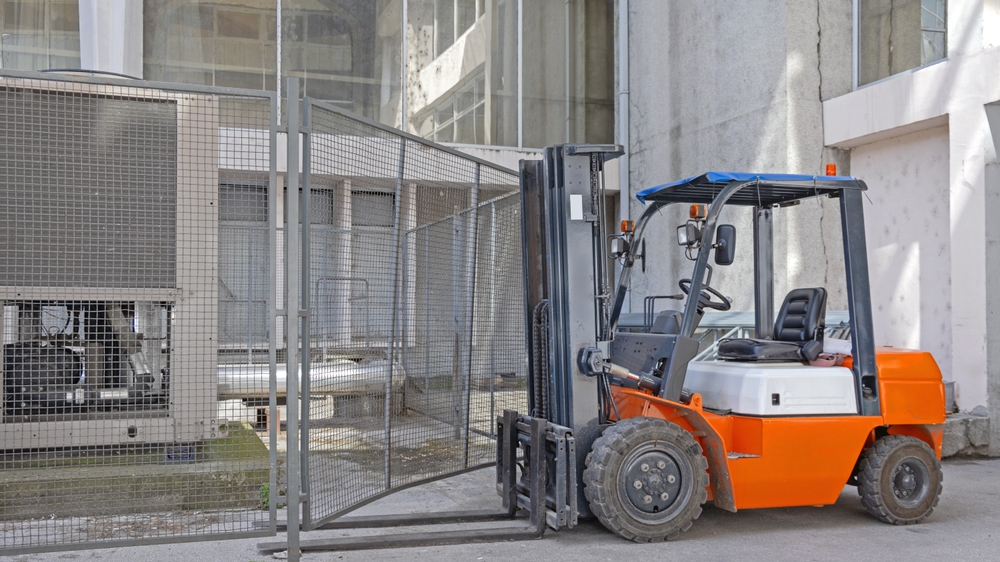
When you watch a forklift effortlessly lift a multi-ton pallet of goods and place it on a high rack, your eyes naturally gravitate toward the vehicle itself. You look at the mast, listen to the hum of the hydraulics, or notice the tight turning radius. Rarely does anyone stop to look at the forks.
To the untrained eye, a forklift fork is just a simple, L-shaped piece of heavy iron. It looks static, indestructible, and entirely uncomplicated.
But talk to any warehouse manager who has dealt with a catastrophic fork failure, or any procurement officer looking at a bill for premature heel wear, and they will tell you a very different story. Forklift forks are highly engineered, dynamic safety components. Left in their raw steel state, they would quickly bend under standard industrial loads or crack under the relentless vibration of a warehouse floor.
The secret to their strength isn’t just the thickness of the metal. It is an invisible, microscopic transformation brought about by advanced metallurgy. At ICHINEN USA, we believe that understanding the science behind your equipment is the first step toward optimizing your operation. Here is a look inside the furnace to see how innovative heat treatment transforms raw steel into an indestructible industrial asset.
In this article, we’ll:
- Uncover the hidden engineering behind forklift forks and why they are critical safety components rather than just simple pieces of iron.
- Break down the science of heat treatment, explaining how molecular processes like quenching and tempering give steel its strength and flexibility.
- Highlight the ICHINEN USA advantage, showcasing the precision manufacturing and rigorous testing that prevent catastrophic fleet failures.
- Translate metallurgy into business value, demonstrating how superior fork construction directly reduces operational costs and extends equipment lifespan.
The Anatomy of a Fork Arm
To understand why heat treatment is so critical, we first have to look at the severe physical forces a fork experiences every single day. A standard forklift fork is divided into three primary zones: the blade (the horizontal section that enters the pallet), the shank (the vertical backpiece), and the heel (the 90-degree bend connecting them).
The heel is the epicenter of stress concentration. When a forklift picks up a heavy load, physics wants to straighten that 90-degree angle out. The top of the heel experiences massive tensile stress (pulling forces), while the inside of the bend experiences intense compressive stress (crushing forces). Furthermore, every time the forklift drives over a dock plate, an expansion joint, or a pothole, those forks flex and vibrate like a tuning fork.
This creates a massive structural paradox for manufacturers:
- If the steel is too soft, the forks will gradually bend downward over time, ruining the load angle and scraping the floor.
- If the steel is too hard, it becomes brittle. Instead of bending under an accidental overload, it will catastrophically snap without warning.
How do you create a piece of steel that is incredibly hard on the outside to resist scraping and wearing, yet flexible enough to absorb thousands of micro-shocks every hour? You change its molecular DNA using heat.
Molecular Magic: Quenching and Tempering
Raw steel is made of iron atoms arranged in a grid, with carbon atoms tucked into the gaps. In its untreated state, this structure (often called pearlite or ferrite) is relatively soft and malleable. If you put a heavy load on it, the layers of atoms easily slide past one another, causing the metal to bend permanently.
To fix this, the steel must undergo a multi-step heat treatment process that alters its crystal structure.
1. Austenitizing (The Reset)
First, the raw forged fork is placed into a specialized industrial furnace and heated to an extreme temperature, typically well over 1,500°F (815°C). At this glowing, red-hot temperature, the steel undergoes a phase change. The iron atoms rearrange themselves into a spacious grid called austenite, which allows the carbon atoms to dissolve uniformly throughout the metal.
2. Quenching (The Lock)
Once the steel reaches perfect uniformity, it is pulled from the furnace and immediately plunged into a liquid bath—usually a highly formulated engineering oil or water. This process is called quenching.
The sudden drop in temperature causes a thermal shock. The iron atoms try to snap back into their original room-temperature grid, but they move too fast for the carbon atoms to escape. The carbon atoms get trapped in the grid, warping it into a highly strained, incredibly tight needle-like structure called martensite. Martensite is extraordinarily hard and completely unyielding. If you tried to use a fork in this state, it would be as hard as a file—but it would shatter like glass if dropped.
3. Tempering (The Balance)
To eliminate that dangerous brittleness, the fork goes back into a lower-temperature furnace (usually between 700°F and 1,000°F) for a precisely timed period. This is called tempering.
Tempering allows the trapped carbon atoms to relax just enough to relieve the internal structural stress. It trades away a tiny fraction of the extreme hardness in exchange for immense toughness and ductility.
- Ductility is the metal’s ability to deform slightly under stress and snap back to its original shape, rather than breaking. Tempering gives the fork its muscle memory.
The ICHINEN USA Advantage
In the world of heat treatment, close enough is never good enough. If a furnace is off by just a few degrees, or if a fork is cooled a few seconds too slowly, you end up with soft spots or micro-cracks inside the steel that cannot be seen by the naked eye. These hidden flaws act as ticking time bombs on a busy warehouse floor.
At ICHINEN USA, our manufacturing innovation centers around precision and uniformity:
- Advanced Atmospheric Furnaces: We utilize state-of-the-art furnaces that ensure the heat is perfectly distributed across the entire length of the fork. The thick heel receives the exact same thermal penetration as the thin tip of the blade.
- Strict Adherence to Standards: Every single fork we produce is manufactured to meet or exceed rigorous international standards, including ISO 2330 and ANSI/ITSDF. These standards mandate strict yield strength and impact toughness thresholds.
- Destructive and Non-Destructive Testing: We don’t just assume the heat treatment worked. Our quality control process involves hardness testing across multiple points of the fork, magnetic particle inspection to detect microscopic surface cracks, and fatigue testing to simulate years of brutal, real-world wear and tear.
Real-World Value: Why Heat Treatment Matters to Your Bottom Line
While metallurgical theory is fascinating, what matters most is how this science translates to daily operations. Investing in forks backed by superior heat treatment yields distinct operational advantages:
| Feature | The Science | The Real-World Benefit |
| Reduced Heel Wear | High surface hardness from precise tempering. | Forks last significantly longer before hitting the 10% wear limit, saving thousands in premature replacement costs. |
| Accidental Overload Protection | High tensile strength combined with structural ductility. | If an operator accidentally overloads a fork, the steel will bend rather than snap, preventing catastrophic dropped-load accidents. |
| Cold Storage Resilience | Optimized microstructure prevents low-temperature brittleness. | Standard steel becomes brittle in freezing environments. ICHINEN forks maintain their impact toughness even in deep-freeze food logistics. |
| Micro-Shock Absorption | High fatigue resistance from uniform grain structure. | The forks easily handle the constant rattling of driving over rough yard terrain or high-speed dock loading without developing stress fractures. |
The Invisible Standard of Safety
A forklift fork is ultimately a safety component. It is the only thing standing between a two-ton payload and the concrete floor—or worse, a nearby pedestrian worker. Treating it as a simple piece of shaped metal is a risk no modern supply chain can afford to take.
At ICHINEN USA, we don’t view heat treatment as a routine box to check in the manufacturing process. We view it as the core science of reliability. By mastering the molecular manipulation of steel, we ensure that every fork delivers maximum lifespan, unmatched durability, and absolute peace of mind for your operators.
Don’t wait for a bent fork or a failed inspection to think about your fleet’s material handling integrity.
Ready to upgrade your fleet’s safety? Contact the ICHINEN USA team today to consult with our product experts, explore our high-performance fork solutions, or request a custom quote for your operations.